
Quite simply, a Merkle Tree is a data structure that allows us to make efficient verifications that data belongs in a larger set of data.
They are commonly used in Peer to Peer networks where efficient proofs of this nature will help increase the scalability of the network.
Let’s take a step back and take a look at a binary Merkle Tree from a high-level. A Merkle Tree is a collection of hashes reduced to a single hash:
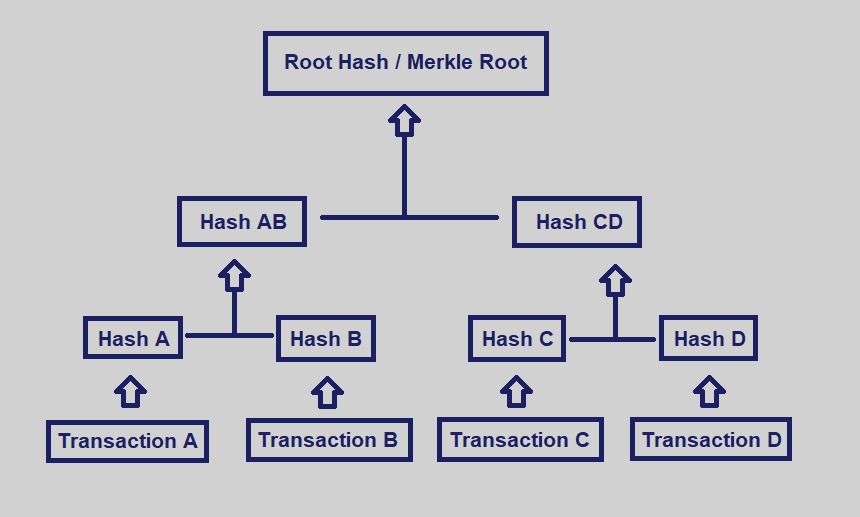 We use letters for convenience in this illustration. Each single letter represents a hash. The combined letters represent concatenated hashes that have been combined and hashed to form a new hash.
Over a series of a steps the four leaf hashes A, B, C and D are combined to create a single, unique hash that allows us to quickly check for inconsistencies without having to look at each individual data point.
As peers in a system, I can simply ask if your root matches mine. If so, we agree. This is a nice optimization for distributed systems of any kind!